

OnOrbit_CRB
A Tactile System connecting crews to Extravehicular Work
A robotic platform designed to connect crews with work happening outside orbital habitats, reducing unnecessary exposure while extending human reach and capability.
Combining autonomous mobility, remote operation, visual inspection, and physical manipulation for verification and EVA support.

Human life is our most
valuable resource in space.
We must build a more connected,
more human way to work in orbit.


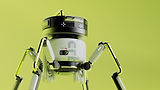

Designed to be handled,
Not just operated
Intentional. Tactile. Familiar.
Not simply a machine operating around them, the form, touchpoints, color, and material choices draw from familiar terrestrial products, creating something approachable and intuitive while still distinctly built for space.
As orbital operations scale, that familiarity becomes increasingly important for the crews, operators, and organizations working with these systems.


System Architecture


Designed to Survive
Thermal + MMOD Protection
CRB lives in one of the harshest environments imaginable. Replaceable outer panels protect against extreme thermal conditions, micrometeoroids, and orbital debris.
When not in use, CRB docks within a protective enclosure, limiting unnecessary exposure while keeping the robot itself lighter and serviceable.
White Beta Cloth
Thin Reflective Insulation layers
Small Air Gap
Rigid Aluminum Shell Panel
Internal Aluminum Structural Frame


Lives + Docks
on Station Exterior

Navigates Autonomously
Along EVA Corridors + Through Remote Teleoperation

Visually Inspects
EVA Planning + Systems Verification + Triage

Interacts Physically
Multi-tool verification + Suspected Damage Regions
+ Planned Maintenance + Testing

01 Mobility + Anchoring
4 Legs. 3 Points of Contact.
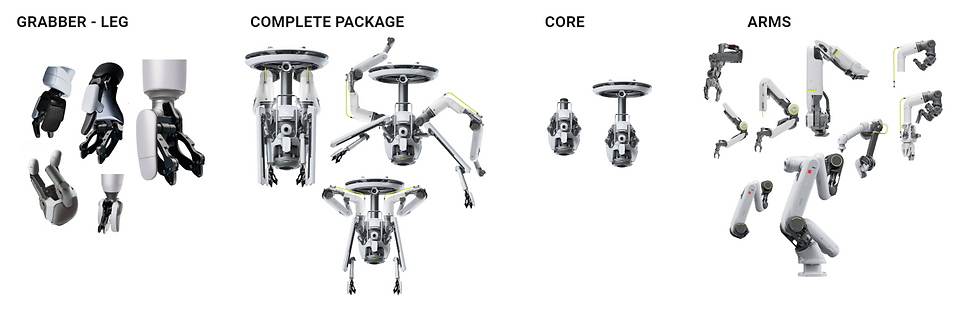
Four articulated legs allow CRB to move across existing station architecture while maintaining three points of contact.
Each leg doubles as both locomotion and anchoring, keeping the system stable while inspecting or interacting with the station.


02 Manipulation +Inspection Arms
Dual Arms. 6 Degrees of Freedom.
Dual manipulation arms give CRB the reach and dexterity to inspect, interact with, and verify station systems.
Interchangeable tools extend that capability for different inspection and EVA-support tasks.


03 Perception + Operator Interface
Navigation + Operator Telepresence
Integrated cameras and sensors support autonomous navigation, close-range inspection, and remote operation.
The perception system connects crews and operators directly to work happening outside the station.


This complex architecture emerged from constraints. Every decision became a balance between capability, complexity, risk, and the realities of operating in orbit.
1
Reduce Complexity: Every additional joint, motor, tool, and mechanism adds capability, but also mass, power demand, and another potential point of failure.
2
Redundancy: Critical operations require multiple points of contact, overlapping capabilities, and safeguards against a single failure compromising the system.
3
Design for the Environment: Vacuum, radiation, thermal cycling, MMOD, limited maintenance, and existing station architecture constrain nearly every decision.
4
Keep Humans in the Loop: Automation extends what crews can do, but inspection, verification, and critical decisions still need clear human oversight and control.
From Unknown to Understood
Researching. Exploring. Testing. Understanding. Simplifying.
This project started in unfamiliar territory. Understanding orbital operations, robotics, EVA, and the constraints of working outside a space station became as important as designing the robot itself.
The final architecture emerged through research, rapid exploration, testing, and repeatedly simplifying ideas until the system felt both capable and believable.




There's More to the Story
One project. One very big board.
This project didn't follow a straight path. The final system came from hundreds of sketches, studies, experiments, dead ends, technical questions, and decisions made across a wide range of tools and mediums.
What’s here is only part of the process. The full project spans everything from early research and AI-assisted exploration to Gravity Sketch, CAD, physical testing, prototyping, and plenty of things that didn't work.


